Managing a hotel means running dozens of moving parts at once. Reservations arrive from multiple channels. Housekeeping schedules shift in real time. Billing errors happen at checkout. And guests expect smooth service at every single touchpoint.
For many years, hoteliers managed these operations through spreadsheets, paper logs, and siloed software. The results were predictable. Overbooking. Revenue leakage. Staff spending hours on tasks a system should handle automatically.
A hotel management system (HMS) solves that problem at the root.
Hotel management system is an integrated software platform that centralizes your hotel's core operations into one place. Reservations, front desk management, housekeeping, billing, channel distribution, and guest communication all run through a single system.
Modern HMS platforms are cloud-based, so your team can manage everything in real time from any device.
Whether you run a 20-room boutique property or a multi-property hospitality group, the right hotel management system becomes the operational backbone of your entire business. It connects your front desk to your finance team. It connects your property to every booking channel you operate on. It connects your hotel to the global travel technology infrastructure your revenue depends on.
In this 2026 complete guide, you'll learn:
A hotel management system (HMS) is software that runs every core operation of your hotel from one platform. It handles reservations, front desk management, housekeeping, billing, and channel distribution. Everything connects. Everything updates in real time. Modern HMS platforms are cloud-based, so your team can access the system from any device, anywhere.
Most hospitality technology conversations use three terms as if they mean the same thing: HMS, PMS, and CRS. They do not. Knowing the difference is the first step to choosing software that actually fits how your hotel operates.
These three systems sit at different levels of your hotel's technology stack, each with a distinct scope of responsibility.
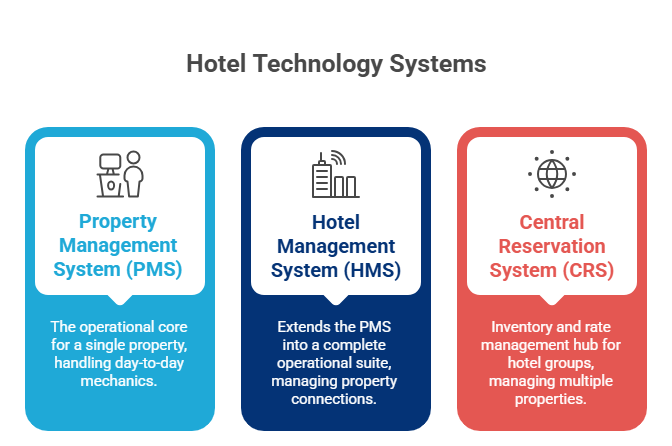
Property Management System (PMS)
A PMS is the operational core, the system your front desk team lives in every shift. It handles the day-to-day mechanics of running a single property: room reservations, check-in and check-out, room assignment, housekeeping status, billing, and basic reporting. Think of a PMS as the engine room of one hotel.
Most independent hotels and smaller properties run on a PMS alone. The limitation: a standalone PMS typically does not include a built-in booking engine, channel manager, or revenue management tools. Those must be integrated separately — adding complexity and cost.
Hotel Management System (HMS)
An HMS builds on the PMS foundation and extends it into a complete operational suite. Where a PMS manages what happens inside the property, an HMS also manages how the property connects to the outside world.
A full HMS bundles the PMS with a booking engine, channel manager, CRM, point-of-sale (POS), revenue management tools, and — critically for travel technology businesses — API integrations with OTAs, GDS networks, and third-party distribution platforms.
For hotels that source bookings through multiple channels simultaneously — direct website, Booking.com, Expedia, travel agencies, corporate accounts — an HMS is not optional. It is the infrastructure that keeps those channels synchronized in real time.
Central Reservation System (CRS)
A CRS operates above the property level. It is the inventory and rate management hub for hotel groups, chains, and multi-property portfolios. Where an HMS manages a single property's operations, a CRS manages how inventory, pricing, and availability flow across multiple properties simultaneously, ensuring a guest booking through any channel, in any market, sees accurate, real-time availability.
Large hotel chains (Marriott, Hilton, IHG) operate enterprise CRS platforms. Independent hotels and boutique properties typically do not need a standalone CRS — a well-configured HMS handles this function at the property level.
The answer depends on three variables: your property size, your booking channel mix, and your technology stack.
Choose a standalone PMS if: You run a small independent property (under 30 rooms), your bookings are primarily walk-in or direct, and you have a separate channel manager already in place.
Choose an HMS if: You manage a mid-size hotel or boutique property that receives bookings from multiple OTA channels simultaneously, needs direct booking capability through your own website, and wants all functions — operations, distribution, and guest management — consolidated under one platform.
Choose or integrate a CRS if: You operate multiple properties, manage a hotel group or franchise, or need centralized inventory and rate management across markets and geographies.
Sriggle's position: Sriggle's Hotel Management System is purpose-built for properties that sit within a broader travel technology ecosystem — connecting your hotel operations directly with OTA APIs, GDS networks, tour operator software, and booking engines in a single integrated environment. If your hotel is part of a travel business or needs deep API connectivity, that distinction matters.
Not all hotel management systems are built the same. The gap between a basic property management tool and a full-featured HMS shows up not in the marketing brochure but in the daily workflows of your front desk team, your housekeeping staff, your revenue manager, and the guests checking in at 11 PM after a delayed flight.
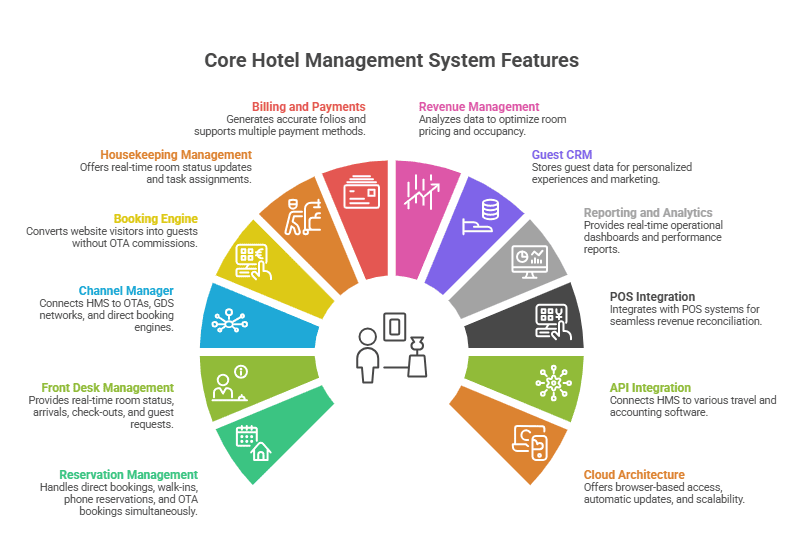
Below are the twelve core features every modern HMS must deliver in 2026, and what to look for in each one.
The reservation engine is the heartbeat of any HMS. It needs to handle direct bookings from your website, walk-in entries at the front desk, phone reservations, and incoming bookings from every connected OTA channel simultaneously, without creating conflicts or requiring manual reconciliation.
What separates a strong reservation module from a weak one is real-time inventory logic. When a room is booked on Booking.com at 2:14 PM, that room must disappear from Expedia, your own website, and every other connected channel within seconds. Any lag in that sync is an overbooking waiting to happen.
Look for: two-way channel sync, reservation source tracking, group booking support, and a visual room calendar your team can read at a glance.
Your front desk module is where reservations become guest experiences. A properly built front desk interface gives your team a real-time view of room status, arrivals for the day, pending check-outs, and any special guest requests attached to a reservation.
Modern HMS platforms extend this beyond the physical desk. Mobile check-in, digital registration, and contactless arrival flows are now expected by a significant portion of travelers. According to the HotelTechReport 2026 PMS Impact Study, 89% of hoteliers report saving 2 to 10 hours per week after implementing a modern front desk system. That time goes back into guest interaction, not paperwork.
Look for: drag-and-drop room assignment, early check-in and late check-out handling, digital registration, and mobile access for staff.
The channel manager is what connects your HMS to the outside world. It distributes your live room inventory and rates across every booking platform you operate on, including OTAs like Booking.com, Expedia, and Agoda, GDS networks used by corporate travel agents, and your own direct booking engine.
A channel manager without two-way integration is a liability, not an asset. You need rate parity enforcement, automated availability updates, and a single dashboard where your revenue manager can adjust pricing across all channels simultaneously without logging into each platform individually.
For hotels operating within a travel technology ecosystem, the channel manager is the point where your HMS connects to third-party booking APIs. This is where Sriggle's architecture has a specific advantage: the system is built to maintain live connections with OTA APIs, GDS feeds, and custom travel API integrations at the same time, without requiring separate middleware.
Look for: real-time two-way sync, rate parity management, OTA and GDS connectivity, and API-level access for custom integrations.
Your booking engine is the direct revenue tool sitting on your hotel website. It converts website visitors into guests without paying OTA commission on every reservation.
A booking engine that is clunky, slow, or not mobile-optimized kills conversions before they start. Guests comparison-shop in real time. If your direct rate is the same as Booking.com but your booking experience is inferior, they will book elsewhere.
Look for: mobile-responsive design, real-time availability display, promo code and package support, secure payment processing, and multi-language capability if you serve international guests.
Housekeeping is where operational efficiency is won or lost on a daily basis. A strong housekeeping module gives your team real-time room status updates tied directly to the front desk, so the moment a guest checks out, housekeeping sees it without a phone call.
Room assignment, cleaning priority queues, maintenance flags, and inspection checklists should all live inside the HMS rather than on paper or a separate app. When housekeeping and the front desk operate from the same data, room turnaround accelerates and guests stop waiting at the desk for a room that has been clean for twenty minutes.
Look for: real-time room status sync, mobile housekeeping app, task assignment by staff member, and maintenance request routing.
Billing errors at checkout damage guest trust faster than almost any other operational failure. Your HMS must generate accurate folios automatically, consolidating room charges, restaurant tabs, spa charges, minibar items, and any other ancillary spend into a single itemized bill.
On the payment side, PCI-DSS compliance is non-negotiable. The system must support multiple payment methods, handle split billing for group reservations, process refunds cleanly, and manage invoicing for corporate accounts on net terms.
Look for: automated folio generation, split billing support, PCI-DSS compliance, multiple payment gateway integrations, and tax configuration by region.
Pricing a hotel room correctly on any given night requires analyzing demand signals, competitor rates, booking pace, local events, and historical occupancy data simultaneously. Static room rates leave money on the table every single night.
A modern HMS includes built-in revenue management tools or deep integration with a standalone RMS. Dynamic pricing rules, rate tier management, length-of-stay restrictions, and occupancy-based rate adjustments should all be configurable inside the system.
Look for: dynamic rate rules, competitor rate monitoring, occupancy-based pricing triggers, and integration with standalone RMS platforms if needed.
Every guest interaction generates data. A guest CRM stores that data and makes it useful: stay history, room preferences, dietary requirements, loyalty status, and communication history all attached to a single guest profile that your team can pull up in seconds.
This is what makes personalization at scale possible. When a returning guest walks in and your front desk team already knows they prefer a high-floor room, a firm pillow, and a late checkout, that is not magic. It is a well-configured CRM.
Look for: centralized guest profiles, preference tagging, stay history tracking, automated pre-arrival and post-stay communication, and marketing segmentation tools.
A hotel that cannot measure its performance cannot improve it. Your HMS should deliver real-time reporting on occupancy rate, average daily rate (ADR), revenue per available room (RevPAR), booking source breakdown, channel performance, and staff productivity without requiring a manual export to a spreadsheet.
Executive dashboards, scheduled report delivery, and property comparison views for multi-property operators are marks of a mature platform.
Look for: real-time operational dashboards, scheduled report delivery, channel performance breakdown, and multi-property consolidation for groups.
Hotels with restaurants, bars, spas, or retail outlets generate revenue across multiple touchpoints. A POS system integrated directly into your HMS means a guest dinner charge posts to their room folio automatically; reconciliation is accurate at checkout, and your finance team is not manually matching two separate systems at the end of the day.
Look for: native POS module or deep third-party POS integration, automatic folio posting, and consolidated end-of-day reporting.
This is the feature that most generic HMS guides skip entirely, and it is the one that matters most to hotels operating inside a larger travel ecosystem.
Your HMS does not operate in isolation. It needs to connect with OTA extranets, GDS networks, travel API providers, payment gateways, accounting software, loyalty platforms, and in some cases, tour operator systems and car rental APIs.
An HMS with an open API architecture means you can connect the tools your business already depends on without rebuilding your stack from scratch. It also means future integrations are possible as your operation scales.
Look for: open REST API, documented integration library, pre-built connectors for major OTAs and GDS networks, and webhook support for real-time data sync.
On-premise HMS installations still exist, but they carry real cost: server hardware, IT maintenance, manual updates, and no remote access when something goes wrong at 2 AM.
Cloud-based HMS platforms run on vendor-managed infrastructure, update automatically, scale with your operation, and give every authorized team member access from any device. For multi-property operators or owners who oversee hotels remotely, cloud access is not a convenience feature. It is a business requirement.
Look for: browser-based access with no local installation, role-based permission controls, automatic software updates, and data backup and redundancy guarantees.
Understanding what an HMS does is one thing. Understanding what it changes inside a real hotel operation is another.
The hospitality industry has spent the last decade generating concrete, measurable data on what happens when properties move from disconnected tools and manual processes to a unified hotel management system. The results are not marginal. They show up in revenue figures, staff hours recovered, guest satisfaction scores, and direct booking percentages.
Here is what the research and operational reality actually show.
Manual processes are the silent tax on hotel operations. Front desk staff reconciling OTA reservations by hand, housekeeping supervisors calling room status in over radio, revenue managers pulling occupancy data into spreadsheets every morning — these tasks consume hours that should go toward serving guests.
The HotelTechReport 2026 PMS Impact Study, which surveyed 450 hotel operators across 150 countries, found that 89% of hoteliers report saving between 2 and 10 hours per week after implementing a modern hotel management system. At the low end, that is over 100 hours per year per property recovered from administrative work alone.
For independent hotels without large back-office teams, that recovery is not a convenience. It is the difference between a manager who has time to think strategically and one who spends every shift firefighting.
An HMS does not just organize your existing revenue. It creates new pathways to earn more of it.
The same HotelTechReport study found that 91% of hoteliers report direct revenue growth linked to PMS and HMS tools, specifically through automated upsells, dynamic pricing, and embedded payment processing. Properties using revenue management features within their HMS report occupancy improvements and ADR gains that outpace properties still using static pricing models.
The mechanism is straightforward. When your channel manager keeps inventory accurate across every OTA in real time, you eliminate the revenue lost to overbooking corrections and last-minute rate discounting. When your booking engine converts direct website visitors at a competitive rate, you reduce OTA commission spend. When your revenue tools adjust room rates dynamically based on demand signals, you capture peak-night revenue that a fixed-rate model leaves behind.
Operational errors in hotels tend to cluster around the same failure points: double bookings caused by unsynchronized channels, billing discrepancies at checkout, housekeeping miscommunication that sends a guest to an unprepared room, and manual data entry mistakes that corrupt guest profiles.
A unified HMS eliminates most of these failure points by design. When one system owns all the data, there is no version conflict between what the OTA says and what the front desk has. When billing pulls directly from the operational record, the folio is accurate before checkout begins. When housekeeping and the front desk share a live dashboard, rooms are assigned based on actual status rather than a radio call from twenty minutes ago.
Fewer operational errors translate directly into fewer guest complaints, better review scores, and improved ranking on OTA platforms that weight guest ratings in their search algorithms.
The guest experience does not begin at check-in. It begins the moment a guest confirms a reservation and receives a confirmation email. It continues through pre-arrival communication, the check-in interaction, every in-property service request, and the post-stay follow-up that either earns a positive review or fails to ask for one.
An HMS with CRM and guest profile functionality gives your team the context to make every one of those touchpoints personal rather than transactional. A returning guest should not have to explain their preferences at check-in. A guest celebrating an anniversary should receive the acknowledgment your team flagged at booking. A guest who complained about noise on their last visit should be assigned a quieter room without being asked.
That level of service does not require a large staff. It requires a system that captures the right information and surfaces it at the right moment.
One of the most underappreciated benefits of a modern HMS is what it does for decision-making at the management level.
When your occupancy data, channel performance, ADR trends, RevPAR, and staff productivity metrics all live inside one system, you stop making pricing and staffing decisions based on gut feeling and start making them based on what is actually happening. Real-time reporting dashboards replace the end-of-week spreadsheet review with a live view of how the property is performing at any moment.
For multi-property operators and hotel groups, this visibility scales. A portfolio dashboard that shows comparative performance across properties, flags underperforming channels, and surfaces revenue opportunities is only possible when all properties run on a connected platform.
Every reservation that comes through an OTA carries a commission cost, typically between 15% and 25% of the booking value. At scale, that is a material line item in your cost structure.
A well-configured HMS attacks OTA dependency on two fronts. First, the booking engine on your own website gives direct bookers a clean, fast, and competitive alternative to OTA platforms. Second, the guest CRM enables post-stay remarketing to previous guests through email, bringing a portion of repeat business back through the direct channel at zero acquisition cost.
Industry data consistently shows that properties with a direct booking strategy built into their HMS technology stack generate a meaningfully higher percentage of commission-free revenue compared to properties without one.
A hotel that grows from one property to three, or from 40 rooms to 120, should not need to rebuild its technology stack to accommodate that growth. A cloud-based HMS scales with the business without requiring new hardware, additional IT infrastructure, or a complete operational retraining.
This scalability is particularly relevant for travel technology companies and hospitality groups managing multiple properties or integrating hotel operations into a broader portfolio of travel products. The system should grow with the business, not become the ceiling on it.
A hotel management system does not operate in isolation. For most modern hospitality businesses, the HMS is one component inside a larger technology ecosystem that includes online travel agencies, global distribution networks, booking engines, payment gateways, tour operator platforms, and in many cases, custom travel API infrastructures built to serve specific markets or business models.
How well your HMS connects to that ecosystem determines not just how efficiently your operation runs, but how much revenue your distribution strategy can actually capture.
This section covers the key integration layers that matter, what each one does, and why the connectivity architecture of your HMS is as important as the features it offers in isolation.
Online travel agencies are the dominant booking channel for most independent hotels globally. Booking.com, Expedia, Agoda, Airbnb, Hotels.com, and dozens of regional platforms collectively drive a significant share of hotel reservations worldwide. Managing those channels manually is not just inefficient. At any meaningful booking volume, it is impossible to do accurately.
OTA integration through your HMS works through a combination of the channel manager module and direct API connectivity to each platform's extranet. When a reservation is confirmed on any connected OTA, the HMS receives that booking instantly, updates the available inventory across every other connected channel in real time, and creates the reservation record in the property management system without any manual input required.
The same logic applies in reverse. When you update your rates, add a promotion, or close out room availability for a specific date, that change propagates to every connected OTA simultaneously rather than requiring a separate login to each platform's dashboard.
For travel technology companies building HMS products into a broader portfolio, the depth and reliability of these OTA connections is a core product differentiator. An HMS that maintains stable, two-way API connections with the major OTA platforms eliminates one of the most common and costly operational failures in hotel management: the overbooking.
The Global Distribution System is the infrastructure layer that connects hotels to the corporate travel market. Travel management companies, corporate travel agents, and airline booking platforms all route accommodation requests through GDS networks, primarily Amadeus, Sabre, and Travelport.
Hotels that are not GDS-connected are effectively invisible to a large percentage of high-value bookings. Corporate travelers overwhelmingly book through GDS-connected platforms; they generally book further in advance, stay longer and generate more ancillary revenue than leisure guests.
An HMS with native GDS connectivity or a deep integration with a GDS switch provider pushes your live room rates and availability into these networks automatically. Rate loading, availability updates, and reservation retrieval all happen at the system level without manual intervention.
For hospitality groups operating in business travel markets, or for travel technology companies building white-label hotel booking products for B2B clients, GDS connectivity is not an optional module. It is a foundational infrastructure.
The booking engine is the interface between your HMS and your hotel website visitors. When a prospective guest lands on your website and searches available rooms, the booking engine queries your HMS inventory in real time and returns accurate availability, rates, and room types instantly.
What makes this integration consequential from a revenue perspective is that every reservation completed through your direct booking engine carries zero OTA commission. The guest books at the same rate they would pay on Expedia, but the full revenue stays with your property.
For travel technology companies building hotel booking capability into a broader platform — an OTA product, a tour operator system, or a B2B travel portal — the booking engine API is the connectivity layer that makes it possible to surface hotel inventory inside a custom interface without rebuilding the underlying reservation logic. Sriggle's HMS is specifically built to support this use case, exposing booking engine functionality through documented APIs that connect with external travel platforms rather than requiring hoteliers to operate exclusively through a proprietary front end.
Payment processing in hospitality is more complex than most industries. A single guest stay can involve a deposit at booking, a pre-authorization on arrival, incremental charges for ancillary services throughout the stay, and final settlement at checkout, all potentially across different payment methods.
An HMS that integrates cleanly with payment gateways handles this complexity at the system level. Charges post to the guest folio automatically. Pre-authorizations are managed without front desk involvement. Refunds process through the same gateway that captured the original payment. PCI-DSS compliance is maintained across every transaction without requiring the hotel to build and certify its own payment infrastructure.
For travel technology platforms connecting multiple hotels through a central booking system, payment gateway integration at the HMS level also enables consolidated financial reporting, multi-currency support, and automated settlement flows that would be operationally prohibitive to manage manually across a portfolio.
Hotels that partner with tour operators, destination management companies, and travel agencies manage a booking channel that operates differently from OTAs. Tour operator bookings typically involve contracted rates, allotment blocks, package inclusions, and net pricing structures that standard OTA channel managers are not designed to handle.
An HMS built for travel technology environments supports these relationships through dedicated contracting modules and travel agency connectivity. Contracted rates load directly into the system. Allotment blocks are managed against live inventory. Net rate calculations and markup management happen at the system level rather than in a spreadsheet maintained separately from the core booking record.
This is the integration layer that most hotel-focused HMS platforms overlook entirely, because most of their customers are independent hotels without direct tour operator relationships. For a travel technology company like Sriggle, whose customer base includes tour operators, OTAs, and destination management organizations alongside individual hotel properties, this connectivity is a core part of the value proposition rather than an edge case.
Beyond the core travel distribution integrations, a mature HMS connects to the broader business software environment a hotel operates in. Accounting platforms like QuickBooks, Xero, or Sage need to receive accurate daily financial data from the HMS without manual export and import cycles. Loyalty program platforms need to read and write guest point balances against reservation records. Reputation management tools need access to guest stay data to trigger post-departure review requests.
An HMS with open API architecture and a documented integration library makes these connections possible without custom development work for every new tool. Webhook support means third-party systems receive real-time event notifications rather than polling for updates on a schedule. Pre-built connectors for common hospitality software categories reduce integration time from months to days.
The quality of a platform's API and its ecosystem of pre-built integrations is increasingly the deciding factor for hospitality groups evaluating HMS platforms. The system that wins is rarely the one with the most features in isolation. It is the one that connects most reliably to everything else the business already depends on.
The right hotel management system for your property depends heavily on what kind of property you are running. A system perfectly suited to a boutique independent hotel will feel overcomplicated and expensive to a 15-room guesthouse, and dangerously limited to a multi-property hospitality group managing hundreds of rooms across multiple markets.
This section breaks down what each property type actually needs from an HMS, which features matter most, and where the common mistakes happen when operators choose a system built for a different category of hotel than their own.
Small independent hotels operate under a specific set of constraints that larger properties do not face in the same way. Staff wear multiple hats. Budgets for technology are tighter. The owner is frequently also the revenue manager, the front desk supervisor, and the person answering guest emails at midnight.
For properties in this category, the most important quality in an HMS is not the length of the feature list. It is the usability of the features that matter most day to day.
A small independent hotel needs a system that handles reservations cleanly, syncs with the two or three OTA channels that drive most of its bookings, generates accurate bills without requiring accounting knowledge to configure, and gives the owner or manager a clear operational picture without demanding hours of setup or training to access it.
What small hotels do not need is an enterprise-grade revenue management system with machine learning pricing algorithms, a multi-property CRS, or a loyalty program engine. Paying for those features while the core reservation and billing functionality is clunky and slow is one of the most common and costly mistakes small operators make when selecting an HMS.
The practical priorities for small and independent hotels are as follows. First, a clean and fast front desk interface that staff can learn in a single day. Second, reliable channel manager connectivity to the platforms that actually drive bookings for that property type and location. Third, a direct booking engine that works on mobile and does not require a developer to configure. Fourth, straightforward billing with tax calculation built in. Fifth, basic reporting that shows occupancy, revenue, and booking source without requiring a spreadsheet export.
Boutique hotels compete on experience rather than price. The guest choosing a boutique property is not looking for the cheapest room in a city. They are looking for a stay that feels considered, personal, and distinct from the standardized experience a chain hotel provides.
That competitive positioning places specific demands on the HMS. Guest profile and CRM functionality becomes genuinely important at this property size, because the ability to remember returning guests, track preferences, and personalize communication is a direct operational expression of the brand promise.
More important at the boutique scale than at a small guesthouse is revenue management. A boutique hotel will generally have higher average daily rates and a wider range of demand by season, local events and booking window. Tools that dynamically price based on real demand signals versus a static seasonal calendar can have a significant effect on annual RevPAR.
Distribution strategy also gets more complicated at this level. Boutique hotels benefit from connecting to niche OTAs that specialize in independent and lifestyle properties alongside the major platforms. An HMS with a channel manager that supports a wide range of OTA connections rather than just the top three or four gives boutique operators more control over their distribution mix.
The practical priorities for boutique hotels include a strong guest CRM with preference tracking and automated pre-arrival communication, dynamic rate management tools that do not require a full-time revenue manager to operate, multi-channel distribution with support for niche and lifestyle-focused OTA platforms, and housekeeping management that reflects the higher service standards these properties are built around.
At mid-size scale, the operational complexity of running a hotel changes in kind rather than just in degree. A 250-room full-service hotel is not simply a bigger version of a boutique property. It has a restaurant, possibly a bar, a spa, a fitness center, event and conference space, and a team of department heads who each need visibility into operational data relevant to their function.
The HMS at this scale needs to do more than manage reservations and front desk operations. It needs to function as a genuine operational platform that connects every department.
Point-of-sale integration becomes a real requirement rather than a nice-to-have feature. When a guest's restaurant charges, spa bookings, and room service orders all need to post accurately to a single folio that reconciles cleanly at checkout, a disconnected POS system creates daily reconciliation problems that consume finance team hours and generate guest-facing billing errors.
Event and group booking management is another capability that becomes critical at this property size. Mid-size hotels frequently host corporate events, weddings, and conference groups that involve room blocks, meeting space, catering, and audio-visual requirements managed under a single group reservation record. An HMS without structured group booking functionality forces these reservations into workarounds that inevitably create errors.
Reporting at this scale also needs to support department-level visibility rather than just property-wide summaries. A food and beverage manager needs different data than the rooms division manager, and both need different data than the general manager reviewing overall performance. Role-based reporting dashboards that surface relevant data to each user without burying them in irrelevant figures are a mark of an HMS built for this property category.
Multi-property operators face a challenge that single-property hotels do not encounter: maintaining operational consistency, rate strategy coherence, and performance visibility across properties that may be in different cities, different countries, and running under different brands.
An HMS for hotel groups needs to solve this challenge at the architecture level, not through a collection of individually configured single-property systems that a corporate team tries to manage separately.
Centralized inventory management means that when a group wants to run a portfolio-wide promotion or adjust rate strategy across properties in response to a market event, that change happens from a single interface rather than requiring logins to every individual property system. Group-level reporting consolidates performance data across the portfolio into comparative dashboards that show which properties are outperforming their market and which need intervention.
Staff management across properties also benefits from a unified platform. Training one system rather than multiple different HMS installations reduces onboarding time, supports staff movement between properties, and maintains consistent operational standards regardless of location.
For travel technology companies managing hotel inventory on behalf of multiple hotel partners, the multi-property architecture serves an additional function. A single HMS platform that manages multiple partner properties under a centralized configuration gives the operator consolidated visibility into partner performance, enables portfolio-level distribution management, and creates a scalable technical foundation for onboarding additional properties without rebuilding the integration stack each time.
The hotel management system landscape is changing faster in 2026 than at any point in the previous decade. The convergence of artificial intelligence, open API architecture, contactless guest expectations, and consolidating distribution channels is reshaping what operators expect from their HMS and what vendors need to deliver to remain relevant.
Understanding these trends matters for two reasons. First, it helps hoteliers evaluate which platforms are investing in the right capabilities and which are maintaining the appearance of innovation without the underlying architecture to support it. Second, it signals whether an HMS you implement today will still serve your operation competently in three years or require replacement before it pays for itself.
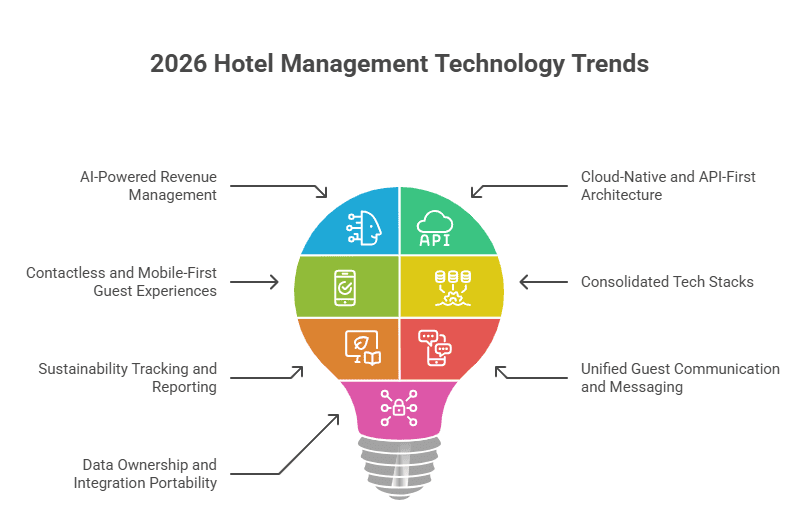
These are the seven trends defining hotel management technology in 2026.
Artificial intelligence has moved from a marketing term into genuine operational infrastructure across the hospitality sector. The most consequential application in 2026 is AI-driven revenue management, where machine learning models analyze demand signals across historical booking data, competitor pricing, local event calendars, weather patterns, and macroeconomic indicators simultaneously to recommend or automatically apply room rate adjustments in real time.
The practical difference between an AI-assisted pricing model and a traditional rule-based dynamic pricing setup is meaningful. Rule-based systems adjust rates when predefined conditions are met, for example raising rates when occupancy crosses 80%. AI models identify non-obvious demand patterns that rule-based logic misses, such as the relationship between a specific corporate event three weeks out and booking pace changes in a particular room category.
According to Cloudbeds, properties using AI revenue intelligence tools report occupancy-driven forecasting accuracy of up to 95% over a 90-day horizon, with revenue lift averaging 18% compared to properties using static or rule-based pricing alone. Those are not marginal improvements. They represent a structural advantage for properties whose HMS delivers this capability natively versus those relying on manual pricing decisions.
The shift from legacy on-premise installations to cloud-native HMS platforms is no longer a trend in the emerging sense. It is effectively complete among newly implemented systems. What is genuinely new in 2026 is the expectation that cloud-based HMS platforms operate on API-first architecture rather than simply being cloud-hosted versions of systems originally designed for local servers.
The distinction matters operationally. A cloud-hosted legacy system gives you remote access to software that was fundamentally designed for a single-property, closed-system environment. An API-first platform is designed from the ground up to expose its data and functions to external systems through documented, stable APIs, making integration with OTAs, payment gateways, revenue tools, CRM platforms, and custom travel technology straightforward rather than a complex project requiring specialist developers.
For travel technology companies building HMS capabilities into a broader product portfolio, API-first architecture is not a preference. It is the minimum viable technical standard. A system that cannot reliably expose its reservation, inventory, and guest data through well-documented APIs cannot function as the operational core of a connected travel platform.
Guest expectations around the check-in and check-out process shifted dramatically during the early 2020s and have not shifted back. A meaningful segment of travelers now expects the option to complete arrival formalities before they reach the property, access their room without visiting the front desk, and settle their account without standing in a checkout queue.
The HMS capabilities enabling this experience include mobile check-in and check-out flows, digital registration with ID verification, mobile key integration with door lock systems, and in-app guest communication channels that allow service requests, housekeeping scheduling, and concierge interaction without requiring a phone call or a physical visit to the front desk.
Properties that have implemented these capabilities report two distinct benefits. Guest satisfaction scores improve among travelers who prefer self-service. Front desk staff are freed from processing transactional arrivals and can direct their attention toward guests who benefit from or prefer personal interaction. The result is a better experience for both guest profiles rather than a trade-off between them.
The hospitality technology market spent roughly a decade pushing hotels toward best-of-breed stacks, the idea that a hotel should choose the best standalone tool for each operational function and integrate them together. The practical reality for most independent and mid-size hotels is that managing seven or eight separate vendor relationships, each with its own contract, support team, update schedule, and integration dependency, creates operational fragility rather than operational excellence.
The 2026 trend is consolidation. Operators are actively reducing the number of systems in their stack and prioritizing HMS platforms that deliver reservation management, channel management, booking engine, CRM, revenue tools, and POS integration within a single platform and a single vendor relationship.
This does not mean all-in-one platforms are universally superior to modular stacks. Large enterprise hotel groups with complex, specialized requirements in specific functional areas still benefit from best-of-breed tools in those areas. But for the independent hotel, the boutique property, and the mid-size operator without a dedicated IT team, a consolidated platform that does everything adequately and connects everything reliably outperforms a collection of specialized tools that theoretically do each function better but create integration overhead that consumes staff time and generates data inconsistencies.
Environmental accountability has moved from a hospitality marketing angle into a genuine operational and regulatory concern. Corporate travel programs in the European Union and increasingly in North America now require hotels to report verified sustainability metrics, including carbon footprint per room night, energy and water consumption data, and waste reduction performance, as a condition of inclusion in preferred supplier programs.
HMS platforms are responding by integrating sustainability tracking modules that capture this operational data automatically rather than requiring manual measurement and reporting. Energy consumption per occupied room, water usage per guest night, and single-use plastic reduction metrics are being surfaced inside operational dashboards alongside the traditional revenue and occupancy KPIs.
For hotels targeting the corporate travel market or participating in sustainable tourism certification programs, an HMS with sustainability reporting capability is transitioning from a differentiator into a baseline expectation.
Guest communication has historically been fragmented across multiple channels: email for pre-arrival confirmations, phone for in-stay requests, review platform messaging for post-stay follow-up, and in some cases SMS or WhatsApp for real-time communication during the stay. Managing those channels separately creates inconsistent response times, missed messages, and a guest experience that feels disjointed rather than considered.
The 2026 standard for HMS guest communication is a unified inbox that consolidates every guest communication channel into a single interface, with AI-assisted response drafting that helps staff handle high message volumes without sacrificing response quality or speed. Some platforms extend this further with automated communication flows that trigger pre-arrival messages, in-stay check-in touchpoints, and post-departure review requests based on reservation milestones rather than manual staff action.
The operational impact is measurable. Properties using unified communication platforms within their HMS report faster average response times, higher review request response rates, and improved scores on the service-related categories of major review platforms.
A quieter but strategically important trend in 2026 is growing operator awareness of data ownership and the risks of vendor lock-in. Hotels increasingly understand that the guest data, booking history, and operational records stored inside their HMS represent genuine business assets, and that choosing a platform that makes that data difficult to export or migrate is a long-term liability.
HMS vendors are responding to this concern with clearer data export policies, open data standards, and contractual commitments around data portability at contract end. For hoteliers evaluating platforms, the questions to ask are specific: can you export your complete guest database in a standard format at any time, what happens to your data if you terminate the contract, and does the platform's API give you programmatic access to your own operational data for reporting and analytics purposes outside the vendor's native dashboard.
For travel technology operators building platforms on top of HMS infrastructure, data portability is not just a contractual concern. It is an architectural one. Building a travel product on an HMS that restricts data access creates a structural dependency that limits what the platform can deliver to its own customers.
Choosing a hotel management system is one of the most consequential technology decisions a hospitality operator makes. The system you select will shape how your front desk team works every shift, how your rooms appear across every booking channel, how your guests experience arrival and departure, and how clearly your management team can see what is actually happening in the business.
Getting that decision right requires more than reading a vendor's feature list. It requires understanding your own operation clearly enough to evaluate whether a given platform actually fits how your hotel works, not just how the vendor's sales demo presents it.
This section walks through the evaluation framework that experienced operators and hospitality technology consultants use when selecting an HMS, and the questions that reveal more about a platform's real-world performance than any demonstration ever will.
The most common mistake hoteliers make during an HMS evaluation is letting the vendor's demo define the conversation. A well-produced demo shows the system at its best, in a controlled environment, with sample data, and guided by someone who has presented it hundreds of times.
Your operation is none of those things.
Before speaking to a single vendor, spend time mapping your actual workflows. How do reservations currently enter your system? Which channels drive the majority of your bookings and what percentage comes from each? Where do your staff spend the most time on manual tasks? What errors occur most frequently and what is their operational cost? Which integrations are non-negotiable because removing them would break something your business currently depends on?
The answers to these questions become your evaluation criteria. Every HMS you assess should be measured against your actual workflows, not against an abstract feature checklist that may or may not reflect how your hotel operates in practice.
A hotel management system with fifty features and three reliable integrations will consistently underperform a system with thirty features and a deep, stable integration ecosystem.
Integration reliability is one of the most under-evaluated dimensions of HMS selection and one of the most consequential after implementation. When your channel manager integration with a major OTA is unreliable, you get overbookings. When your payment gateway integration is slow or error-prone, you get billing failures at checkout. When your accounting integration requires manual reconciliation, you get finance team hours consumed by a task the system was supposed to eliminate.
Ask every vendor you evaluate for specific documentation on how their OTA integrations work at a technical level, what the update frequency is for inventory and rate synchronization, what happens when the connection drops and how the system handles reconnection, and whether the integration is maintained through a direct API connection to the OTA or through a third-party channel manager middleware that introduces an additional dependency.
For travel technology operators, the integration question extends further. Ask explicitly whether the HMS exposes its reservation and inventory data through a documented, stable API, what the rate limits and authentication model look like, and whether there are existing clients using the API to build custom travel products on top of the platform. The answers reveal whether the system was designed for connectivity or merely tolerates it.
HMS pricing is almost universally presented at the subscription level, typically a per-room, per-month figure that looks manageable in isolation. The full cost of operating an HMS over a three-year period looks substantially different once you add the components that are frequently omitted from initial pricing conversations.
Implementation and data migration costs vary enormously between platforms. Some vendors charge a flat onboarding fee. Others bill by the hour for setup work that turns out to be more complex than the initial estimate. Ask for a complete implementation cost breakdown in writing before signing anything.
Integration costs are another category that surprises operators after commitment. Some HMS platforms charge additional fees for connecting to specific OTAs, payment gateways, or third-party tools. Others include a standard integration library in the base subscription but charge for custom API work. Understanding exactly what is included and what triggers an additional charge is essential before comparing platforms on price.
Training costs, particularly for properties with high staff turnover, can be significant over a multi-year contract. Ask whether training materials are included, whether there is a self-service knowledge base your team can access without scheduling a session with the vendor, and what retraining support looks like when a new general manager or front desk supervisor joins.
Finally, consider switching costs when the contract ends. A platform that makes data export straightforward and migration support available gives you genuine negotiating leverage at renewal time. A platform that makes leaving difficult effectively increases the real cost of the subscription from year one, even if that cost is not visible in the initial pricing.
Vendor-provided case studies are curated to show the system performing well. They are useful as a starting point and inadequate as a final reference.
Ask every vendor you are seriously evaluating to connect you with two or three current customers operating properties that resemble yours in size, type, and booking channel mix. A boutique hotel reference is not useful when you are evaluating an HMS for a 200-room full-service property. A single-property reference is not useful when you are evaluating a platform for a multi-property group.
When you speak to those references, ask specific questions rather than general ones. Ask how the implementation actually went compared to what the vendor represented. Ask which features they use daily and which they were sold on but have not used since onboarding. Ask what broke in the first six months and how the vendor responded. Ask whether they would make the same decision again and, critically, ask whether there is anything they wish they had asked the vendor before signing.
Those conversations will tell you more about a platform's real-world performance than any demonstration, any review aggregator score, and any feature comparison matrix.
An HMS failure during a sold-out weekend is not a minor inconvenience. It is a guest experience crisis, a potential revenue loss event, and a staff morale problem happening simultaneously. How your vendor responds in that moment depends entirely on the support infrastructure they have built, not on what the support section of their website says.
Before committing to a platform, test the support model during your evaluation period. Submit a technical question through the support channel and measure the response time and quality. Ask whether there is 24-hour support available and in what form, whether phone support is included or only available on higher-tier plans, and what the escalation path looks like when a critical issue requires immediate resolution.
Ask specifically about implementation support. The weeks immediately following an HMS go-live are the period of highest risk. Staff are learning a new system, migration data is being validated, and integration connections are being tested under real booking conditions. A vendor that provides dedicated implementation support through this period reduces risk substantially compared to one that hands you a knowledge base article and considers onboarding complete.
Use this framework when assessing any HMS platform against your specific operation.
Operational fit: Does the system handle your actual booking channel mix without workarounds? Can your staff realistically operate it without weeks of training? Does the housekeeping and front desk workflow match how your team actually works rather than requiring you to adapt your operation to the software?
Integration reliability: What is the documented update frequency for OTA inventory sync? Are integrations direct API connections or middleware-dependent? Is there an open API with documentation available for review before purchase?
Total cost clarity: Is the implementation cost fixed or variable? Are integrations included or charged separately? What does the data export process look like at contract end?
Vendor stability: How long has the vendor been operating? What is their customer retention rate? Are they actively investing in the platform with regular feature releases or maintaining a legacy codebase?
Support quality: Is 24-hour support available and at what tier? What is the average response time for critical issues? Is there a dedicated implementation support contact or a general helpdesk queue?
Scalability: Can the platform grow with your operation without requiring migration to a new system? Does it support multi-property management if that becomes relevant? Does the API architecture support building additional travel products on top of the HMS if your business model requires it?
A hotel management system is not a software purchase. It is an operational decision that shapes how your property runs every single day, how your rooms reach guests across every booking channel, how your team spends its time, and how clearly you can see the business performing in real time.
The difference between an HMS that fits your operation and one that does not is not always visible in a sales demonstration. It shows up six months after go-live, in the workarounds your staff have built around the system's limitations, in the integrations that never quite work reliably, and in the operational time that was supposed to be recovered but never was.
The properties that get this decision right follow the same pattern. They start by understanding their own operation precisely before engaging with vendors. They weight integration reliability and total cost of ownership alongside feature count. They speak to references from properties like their own rather than relying on curated case studies. And they choose a platform whose architecture is built to grow with the business rather than one that requires replacement the moment the operation evolves beyond its current configuration.
For hotels operating within a broader travel technology ecosystem — properties connected to OTA platforms, GDS networks, tour operator systems, and custom booking APIs — the HMS decision carries an additional dimension. The system needs to function not just as a property operations platform but as the integration layer connecting hotel inventory to the wider travel distribution infrastructure the business depends on.
That is precisely the operational environment Sriggle's Hotel Management System is built for. Designed specifically for travel technology businesses and hospitality operators who need deep API connectivity alongside comprehensive property management functionality, Sriggle connects your hotel operations directly with the OTA, GDS, and travel API infrastructure your business runs on — without requiring separate middleware or custom development work for every new connection.
If you are evaluating hotel management systems for a property that sits within a travel technology platform, manages bookings through multiple API-connected channels, or needs an HMS that integrates with a broader portfolio of travel products, we would be glad to show you how Sriggle approaches that specific challenge.
Explore Sriggle's Hotel Management System or book a free demo to see the platform working inside a real travel technology environment.