Most DMCs run on three things: email threads, Excel rate sheets, and a shared folder nobody can find anything in.
That setup works. Right up until it doesn't.
A tour operator wants a quote in two hours. A supplier changes rates mid-season without warning. Your ops team is chasing 14 confirmations before Friday while finance is still untangling last month's invoices.
This isn't a bad week. It's a typical one.
Travel technology for DMCs fixes this, not by adding more software to an already messy stack, but by replacing the whole thing with one system built around how DMCs operate.
We've worked with destination management companies across 50+ countries. This guide is built on what we've seen work, what we've seen fail, and what shifted in 2026 that makes getting this decision right more consequential than it used to be.
By the end, you'll know which systems your operation genuinely can't run without, what separates purpose-built DMC platforms from generic travel software with DMC features bolted on, and the questions worth asking any vendor, including us.
Travel technology for DMCs is purpose-built software for destination management companies. It runs your full operation in one connected system — contracts, live inventory, quotes, reservations, and financial reporting.
It's not the same as standard travel software. Not even close.
A typical booking platform does one thing: sells travel. Search, book, pay. Done.
A DMC doesn't sell travel. It builds it.
You negotiate net rates with hotels, ground handlers, activity providers, and guides. You package local services. You manage ground operations. Then you distribute finished products to tour operators, OTAs, and travel agencies who sell them to travellers.
That's a completely different workflow — and it needs completely different software.
Most travel software is built for the demand side. DMCs operate on the supply side. That distinction changes everything about how the technology needs to work.
SITE — the Society for Incentive Travel Excellence — describes DMCs as specialized ground operators. Local expertise. Supplier relationships. On-the-ground infrastructure. Good DMC technology is built around all three. Not adapted from a retail booking engine.
DMC travel technology covers six areas:
Take any one away and your team fills the gap by hand. That's where the errors come from. The delays. The margin losses that are hard to trace back to a single cause.
A travel agency sells travel. A DMC delivers it.
Simple distinction. Enormous operational difference.
Here's exactly what that means for the technology your operation needs.
Generic booking software starts at the point of sale. A DMC's operation starts long before that.
You're negotiating contracts, loading net rates, and building products before any tour operator sends a single enquiry. By the time a traveller is browsing, you've already done the work that most travel software can't even see.
That's why generic tools consistently fail DMCs. It's not a configuration problem. It's a design problem.
Your clients aren't browsing packages on a sunday evening. They're professional tour operators, corporate travel managers, and OTA buyers. They expect accurate pricing, fast turnaround, and consistent documentation every single time.
One slow quote doesn't just lose a booking. It loses a relationship.
B2C travel technology is built for volume. High traffic, simple transactions, quick checkout. B2B DMC technology needs something completely different — accuracy, flexibility, and professional-grade output. Using one for the other shows immediately. To your clients, not just your team.
A retail agency marks a published rate. The margin is visible. The risk is low.
A DMC is different. You're managing negotiated net rates, private deals, currency exposure, and client-specific pricing rules at the same time. One pricing error on a group booking doesn't cost you a small commission. It costs you the margin on an entire contract.
Manual processes can't protect you from this reliably. The right technology handles it automatically before the quote goes out, not after.
"Let me check with the supplier and get back to you" used to be acceptable. It isn't anymore.
Tour operators now expect live availability and instant confirmation. If you can't provide it, they find a DMC that can. It really is that straightforward.
Speed of response is now a direct competitive differentiator in destination management. Technology is what makes that speed possible, without adding headcount every time enquiry volume grows.
These four pressures don't exist in isolation. They compound. A slow quote on a complex itinerary, built from outdated rates, sent to a B2B buyer who needed it an hour ago; that's not one problem. That's all four hitting at once.
That's the operational gap purpose-built DMC technology is designed to close.
We covered the six areas of DMC travel technology above. Here's what each one actually does and why removing any single one creates a gap your team ends up filling manually.
Every DMC operation starts with supplier contracts.
Hotel net rates. Transfer agreements. Activity pricing. Guide fees. These numbers run your business. If they live in spreadsheets or email attachments, they get outdated, misread, or missed entirely.
Contract management technology fixes this. Load a supplier rate once. Set validity periods, blackout dates, and pricing rules. Every quote your team builds pulls from the same accurate source.
No more "which version of the rate sheet are we using?"
Quoting is where DMCs win or lose business. Full stop.
A tour operator sends an enquiry. Seven nights. Airport transfers. Three activities. A private guide. They need a price by tomorrow morning.
Without the right technology, your team builds this by hand. Pull rates from different files. Calculate margins. Format a document. Send it, and hope nothing was missed.
With a quotation engine, the same quote takes minutes. Select services, apply pricing rules, generate a professional proposal. The client gets it fast. Your margin is protected. One click converts it to a booking.
Faster quotes mean more quotes. More quotes mean more bookings. It's the single module with the most direct impact on DMC revenue.
Supplier availability changes constantly.
A hotel blocks rooms for a conference. A guide takes a week off. A transfer provider runs short on vehicles over a public holiday. If your system doesn't reflect these changes in real time, you end up confirming something you can't actually deliver.
Then comes the conversation nobody wants. Calling a tour operator to explain why a confirmed service is suddenly unavailable. That call damages relationships in ways that take months to repair, sometimes permanently.
Live inventory connectivity pulls real-time availability directly from suppliers. What you quote is what you can book. No phone calls. No awkward callbacks.
A confirmed quote is just the beginning.
Vouchers go to suppliers. Pickup times get confirmed. Rooming lists go to hotels. Guides need their schedules. Transfers need assigning.
Without a central system, all of this happens over email. Slow. Hard to track. Easy to miss.
Reservation and operations technology connects the booking to the delivery. Everything triggered after a client confirms gets tracked and managed in one place. Your ops team always knows what's confirmed, what's pending, and what needs attention today.
Most DMC revenue comes from B2B partners — tour operators, OTAs, and travel agencies selling your destination to their own clients.
Managing this manually means emailing rate sheets, chasing availability updates, and processing booking requests one by one. It doesn't scale and it shouldn't have to.
A B2B partner portal changes the model entirely. Partners log in, search your live inventory, build itineraries, and confirm bookings without contacting your team for routine requests.
You handle more volume without adding headcount. Your partners get the self-serve experience they increasingly expect. Every booking flows straight into your reservation system automatically.
DMC finances are genuinely complicated.
Multi-currency supplier invoices. Client billing in different currencies. Commission structures that vary by partner. Group bookings where costs and revenues stretch across months.
Push all of this through a generic accounting tool and you're reconciling manually. Every booking re-entered by hand. Every exchange rate checked separately. Every supplier invoice matched one by one.
Travel-specific financial technology handles it inside the same system your operations team already uses. Invoices generate automatically from confirmed bookings. Supplier costs match to reservations. Margins are visible per booking, per client, and per destination in real time.
Your finance team stops reconciling. Your leadership team stops waiting three weeks for last month's numbers.
These six aren't optional add-ons. They're the operational foundation of a modern DMC.
Running without all six or running them across disconnected tools carries a cost your competitors on the right platform aren't paying. Every single month.
DMC technology has changed more in the last two years than in the previous decade.
According to the World Tourism Organization, international tourist arrivals continue recovering strongly, creating both opportunity and operational pressure for destination management companies managing increasing visitor volumes.
The DMCs pulling ahead of their competitors right now are not just using better software. They are using software differently, letting automation handle the repetitive work so their teams can focus on what builds client relationships.
Here is what is changing and what forward-thinking DMCs are already implementing.
Pricing a DMC service has always involved guesswork.
You know your costs. You know your target margin. But do you know what your competitors are charging for a similar private tour in the same destination this season?
AI pricing tools now answer that question automatically. They scan comparable services
across the market, surface current pricing benchmarks, and flag when your rates are
significantly above or below the market average.
The result: DMCs stop leaving margin on the table by underpricing — and stop losing quotes by overpricing. Pricing decisions become data-driven instead of instinct-driven.
This technology is no longer experimental. DMCs using AI pricing tools in 2026 are setting rates faster, more confidently, and with measurably better margins.
Building a detailed itinerary from a client brief used to take hours.
Read the email. Identify the requirements. Pull the right services. Check availability. Calculate pricing. Format the document. Send it and hope nothing was missed.
AI-assisted itinerary tools now read the client brief and generate a structured draft automatically. Your team reviews, adjusts, and sends instead of building from scratch.
For DMCs handling high volumes of FIT requests, this changes everything. Response times drop from hours to minutes. Your team handles more enquiries without working longer hours. And clients get faster answers, which increasingly is the deciding factor in which DMC they choose.
Tour operators no longer accept "let me check with the supplier and come back to you."
The expectation in 2026 is live availability and instant confirmation. If you cannot confirm a service in real time, a competitor who can will get the booking.
Real-time supplier connectivity via direct API integration between a DMC platform and
its supplier network makes this possible. Hotels, transfer providers, activity operators, and guides push live availability directly into your system.
What you quote is what you can book. Immediately. Without a phone call.
DMCs investing in supplier connectivity are not just improving their response times.
They are fundamentally changing what their tour operator partners can rely on them for.
The way tour operators want to work with DMCs is changing.
A growing number of tour operators particularly mid-sized and larger operators with dedicated product teams want to search DMC inventory, build itineraries, and confirm bookings without going through a salesperson for every request.
B2B self-serve portals give them exactly that.
Your partner logs into a branded portal. They search your live inventory. They build their own package. They confirm it directly. The booking flows into your system automatically.
Your team handles exceptions, relationships, and complex requests not routine bookings they could handle themselves.
DMCs offering self-serve B2B access are winning more partner accounts. Those without it are increasingly being treated as a last resort rather than a preferred supplier.
For DMCs looking to understand how a B2B travel portal works in practice — and what to look for when evaluating one — this is worth reading before your next vendor conversation.
Most DMCs know their total revenue. Fewer know which destinations, products, or partners are actually driving their margin.
Advanced reporting tools built into DMC platforms are changing this. Real-time dashboards now show bookings, revenue, margins, and partner performance — broken down by destination, product type, season, or client.
That data has immediate commercial value.
Which products have the highest margin? Which tour operator sends the most volume but negotiates the hardest on rate? Which destination is growing fastest in enquiry volume but lowest in conversion?
DMCs answering these questions with data are making better product decisions, smarter partner negotiations, and more accurate forecasts. DMCs without this visibility are making the same decisions they made five years ago based on gut feel and last year's spreadsheet.
DMCs increasingly operate across multiple destinations, multiple currencies, and multiple regulatory environments.
A DMC based in Dubai might manage operations across UAE, Oman, and Saudi Arabia. A European DMC might serve destinations across six countries with six different tax frameworks.
Managing this manually — converting currencies, applying the right tax rates, reconciling across markets is where finance teams lose weeks every month.
Multi-currency financial technology built into DMC platforms handles currency conversion, local tax compliance, and cross-market reconciliation automatically.
As DMCs expand geographically, this is no longer a nice-to-have. It is the infrastructure that makes expansion possible without proportionally expanding your finance team.
These are not future trends. DMCs adopting this technology in 2026 are not early adopters taking a risk. They are catching up with a competitive baseline that is already shifting beneath them.
The gap between DMCs running on modern travel technology and those still relying on email and spreadsheets is not closing. It is widening every quarter.
Every DMC faces operational problems that feel unique to their business. Most of them are not.
After working with destination management companies across UAE, UK, Malta, and South America, the same five problems appear in different destinations, different sizes of operation, different markets.
Here is what they are. And exactly how the right travel technology for DMCs resolves them.
The situation:
A tour operator sends an enquiry on Monday morning. They need a 10-day itinerary with hotels, transfers, guides, and three activities across two destinations. They are talking to three DMCs simultaneously. The first one to respond with an accurate price usually wins the business.
Your team takes six hours to build the quote manually.
The technology fix:
A quotation engine connected to live contract rates eliminates the manual build. Your team selects services, applies pricing rules, and generates a professional proposal in minutes not hours.
The outcome:
You respond first. You win more quotes. Your team handles three times the enquiry volume without working longer hours.
Speed of quoting is now a direct revenue driver for DMCs not just an operational efficiency metric.
The situation:
A tour operator calls to query an invoice. The price does not match the quote they received three weeks ago. Your team digs through the files.
Somewhere between the supplier's rate update, the Excel pricing sheet, and the quote template, something changed. Nobody knew which version was current.
This was not fraud. It was not incompetence. It was three versions of the same rate sheet saved in two different folders.
Now you are explaining to a key partner why their invoice is wrong. That conversation costs more than the billing error ever did.
The technology fix:
Contract management technology removes the version problem entirely. Supplier rates load once into one system with validity periods, blackout dates, and currency rules attached. Every quote your team builds pulls from that single live source. Not a file someone last updated in February.
When a supplier changes the rate, it updates in the system immediately. Your team sees it. Every quote after that point reflects the correct number automatically.
The outcome:
Wrong rates stop reaching clients. Margin is protected at the point of quoting — not discovered when the invoice goes out. Partners stop querying invoices. Your team stops correcting them.
For DMCs managing contracts across dozens of suppliers in multiple currencies, this is not a minor improvement. It is the difference between a business that quotes with confidence and one that spends half its time fixing errors that should never have left the system.
The situation:
A tour operator calls on Friday afternoon. Their client wants to add a private desert safari tomorrow morning. Can you confirm by 5pm today?
You email the supplier. No response. You call. Voicemail. You try a backup supplier. They have availability but you are not sure of the rate. You go back to the operator with an approximate price and a promise to confirm Monday.
They book it elsewhere.
The technology fix:
Direct supplier connectivity means live availability from your supplier network inside your platform. No email. No phone call. You check availability, confirm the rate, and respond to the operator in minutes.
The outcome:
Last-minute requests become last-minute revenue instead of last-minute stress. And your reputation with tour operators as a DMC that can always deliver regardless of timing becomes one of your strongest competitive advantages.
The situation:
Your DMC has excellent destination knowledge, strong supplier relationships, and a reliable operation. But outside your existing partner network, nobody knows you exist.
New tour operators searching for DMC partners in your destination find your competitors first not because they are better, but because they are more visible.
The technology fix:
A B2B marketplace connection puts your services in front of OTAs, tour operators, and travel agencies actively searching for DMC partners in your destination.
You list your inventory. Partners find you. They book directly without a middleman taking a percentage.
The outcome:
Your partner network grows without a dedicated sales team cold-calling prospects. New revenue comes from partners you would never have reached through traditional relationship-building alone.
See how Sriggle's destination management software handles B2B partner distribution and marketplace visibility →
The situation:
It is the 15th of the month. Your MD asks for last month's margin by destination.
Your finance team needs three days. They are still matching supplier invoices to bookings, reconciling multi-currency transactions, and pulling numbers from two separate systems into a spreadsheet that was last updated by someone who left six months ago.
By the time the report arrives, the decisions it should inform have already been made based on nothing.
The technology fix:
Financial accounting built directly into your DMC platform means every booking automatically generates its revenue and cost entries. Supplier invoices match to reservations automatically. Multi-currency transactions convert at the correct rate at the point of booking.
Your MD opens a dashboard. The numbers are there. Current. Accurate. Broken down by destination, product, and partner.
The outcome:
Your finance team shifts from reactive reconciliation to proactive financial management. And your leadership team makes decisions based on what is happening now not what happened six weeks ago.
None of these problems are unique to your DMC. And none of them require more staff to solve. They require better systems.
The right destination management software addresses all five inside one platform, without a stack of separate tools your team has to manually connect.
Not all DMC software is equal.
Some platforms are built specifically for destination operators. Others are generic travel tools with DMC features bolted on. The difference is not always obvious from a demo or a feature list.
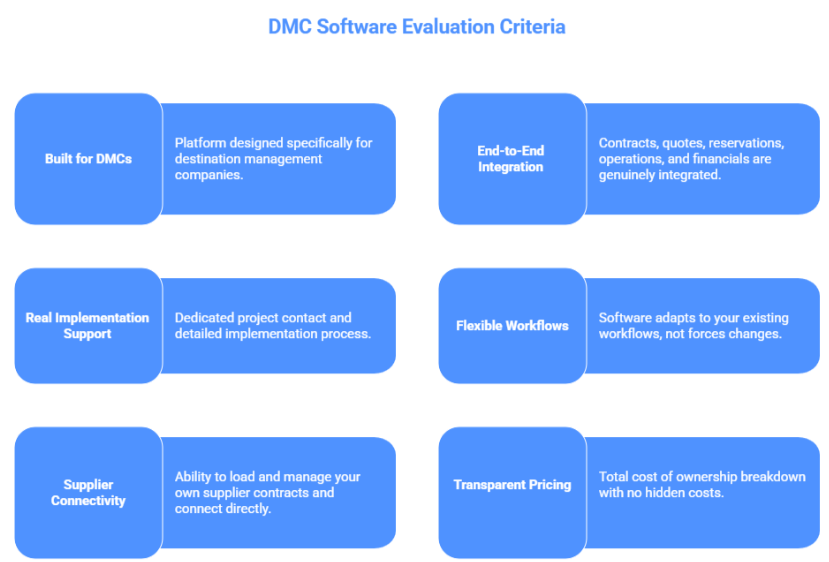
Here is what to actually evaluate before you sign a contract.
This is the most important question to ask any software vendor.
Was this platform designed from the ground up for destination management companies? Or was it originally built for travel agencies, tour operators, or OTAs and then modified to include DMC features?
The difference shows up in the details.
A platform built for DMCs structures everything around supplier contracts and B2B distribution. The contract is the starting point. Everything else — pricing, quoting, booking, operations, and finance flows from it.
A platform adapted for DMCs tends to structure everything around customer bookings. The contract management module feels like an afterthought because it was.
Ask the vendor directly: what percentage of your clients are DMCs? If the answer is less than half, keep looking.
Many platforms sell you a core system and then charge separately for every additional module.
By the time your operation is fully covered, you are paying for five products that still do not talk to each other properly.
Look for a platform where contracts, quotes, reservations, operations, and financials are genuinely integrated, not bolted together through workarounds.
Ask to see a single booking flow from enquiry to supplier invoice in a live demo. If the demonstrator switches between screens, logs into a different system, or exports to a spreadsheet at any point that tells you everything.
Software implementation is where most DMC technology projects fail.
Not because the software is wrong. Because the transition from old systems to new ones is complex and most vendors hand you a login, a library of tutorial videos, and wish you luck.
Loading your supplier contracts takes time. Migrating historical booking data takes time. Training your team on new workflows takes time. And during all of that, your operation still needs to run.
Ask specifically: who will manage our implementation? Is there a dedicated project contact? What does week one actually look like?
A vendor who cannot answer those questions in detail has not built an implementation process — they have built an excuse.
No two DMCs operate identically.
A DMC in Dubai managing luxury desert experiences has different workflows to a DMC in Malta managing Mediterranean sailing itineraries. A DMC handling corporate MICE events has different requirements to one focused on high-volume FIT bookings.
Good DMC technology adapts to how you work, it does not force you to change how you work to fit the software.
During your evaluation, bring your most complex booking scenario — the one that currently takes your team the longest to handle. Ask the vendor to show you how their platform handles it.
If they cannot or if the answer is "you would handle that outside the system" — that is a clear signal this platform was not built for operations like yours.
Every DMC platform claims supplier connectivity. Not all of them mean the same thing.
Some platforms connect to a fixed list of global bed banks and GDS providers. That is useful for generic inventory but it is not your private supplier network.
The connectivity that matters most for DMCs is the ability to load and manage your own supplier contracts, apply your own net rates, and where relevant, connect directly to preferred suppliers via XML or API.
Ask for a specific list of which suppliers the platform connects to and whether your existing key suppliers are on that list. A vendor who responds with a vague answer about "extensive connectivity" is not answering the question.
DMC software pricing models vary enormously.
Some platforms charge a flat monthly fee. Others take a percentage of booking value. Others charge per user, per booking, or per API call.
None of these models is inherently wrong but hidden costs buried in contract terms are a genuine problem in this market.
Before signing anything, ask for a total cost of ownership breakdown that includes: implementation fees, data migration costs, training costs, integration fees for any third-party systems you need to connect, and the cost of any modules not included in the base price.
The vendor who gives you a complete, honest answer to that question without hesitation is the vendor who understands what a long-term partnership looks like.
Choosing DMC travel technology is not a software decision. It is an operational decision.
The platform you choose will shape how your team quotes, how your suppliers connect to you, how your partners experience working with your DMC, and how clearly your leadership team can see what is actually happening in the business.
Take the evaluation seriously. Ask hard questions. And do not sign until you have seen your most complex workflow handled inside a live system.
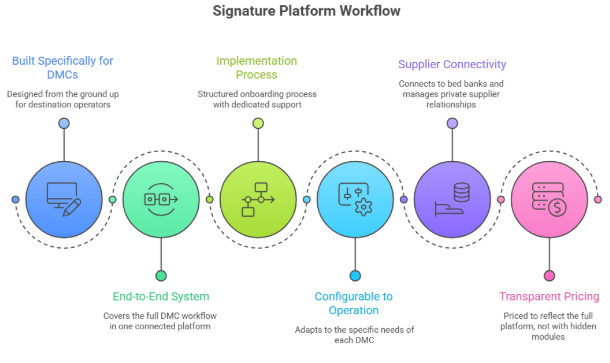
In the previous section, we outlined six things to look for when choosing DMC travel technology.
Signature — Sriggle's platform for destination management companies — was built with every one of those criteria in mind.
Here is how it maps to real DMC operations.
Signature is not a travel agency system with DMC features added later.
It was designed from the ground up for destination operators — inbound and outbound DMCs, ground handlers, and destination management organizations managing complex multi-supplier operations.
The platform is structured around the supplier contract not the customer booking. That single architectural decision changes how every workflow inside the system behaves and why DMC teams find it more intuitive than generic alternatives they have used before.
Signature is used by DMCs across UAE, UK, Malta, and South America — operators managing everything from luxury desert experiences to Mediterranean sailing itineraries to high-volume corporate MICE operations.
Signature covers the full DMC workflow inside one connected platform.
Contract management → Pricing engine →
Inquiry management → Quotation engine →
Reservation management → Operations →
Financial accounting → Reporting →
Business CRM → Visitor CRM → Content management.
Every module is connected. A rate loaded in contract management feeds directly into the quotation engine. A confirmed quote creates a reservation automatically.
A completed reservation generates the financial entries — without re-entering data into a separate system.
Your team works in one place. Your data lives in one place. Your operation runs on one version of the truth.
Sriggle's onboarding process is structured not a library of videos and a login.
When a DMC goes live on Signature, there is a dedicated implementation process that covers supplier contract loading, system configuration, team training, and go-live support.
Most DMCs are fully operational on Signature within 8 to 12 weeks, depending on the size of their supplier network and the complexity of their configuration requirements.
The implementation team works alongside our operation from day one. Not to hand over a finished product but to make sure your team is confident running it independently before the project closes.
No two DMCs using Signature work identically and the platform does not expect them to.
Pricing rules, margin structures, quotation templates, partner portal branding, and reporting dashboards are all configurable to your operation.
A DMC managing private luxury itineraries needs different quotation templates to one handling high-volume group bookings. A DMC distributing to 200 B2B partners needs different portal configurations to one managing 15 key accounts directly.
Signature adapts to the operation not the other way around.
Signature connects to major bed banks including Hotelbeds and Webbeds giving DMCs access to third-party inventory alongside their own supplier contracts.
More importantly, it is built to manage your private supplier relationships — the net rates, exclusive deals, and local partnerships that are the actual competitive advantage of any DMC.
Your contracts load once. Your rates stay current. Your team quotes from live, accurate data whether the service is a private hotel deal, a local activity provider, or a third-party bed bank.
For DMCs requiring direct XML or API connectivity with specific suppliers, Sriggle's technical team works with you to build those integrations into your implementation.
Signature is priced to reflect the full platform not a base system with premium modules sold separately.
The quotation engine, B2B partner portal, financial accounting, and reporting dashboards are part of the platform not add-ons that increase your monthly cost every time your operation grows.
For specific pricing based on the size of your operation and your implementation requirements, contact Sriggle's team directly. Every conversation starts with understanding your operation not presenting a price list.
If you are evaluating DMC travel technology and want to see how Signature handles your specific workflows, bring your most complex booking scenario to a demo.
That is the fastest way to know whether this platform is right for your operation.