What Is a GDS (Global Distribution System) in Travel?
The short answer
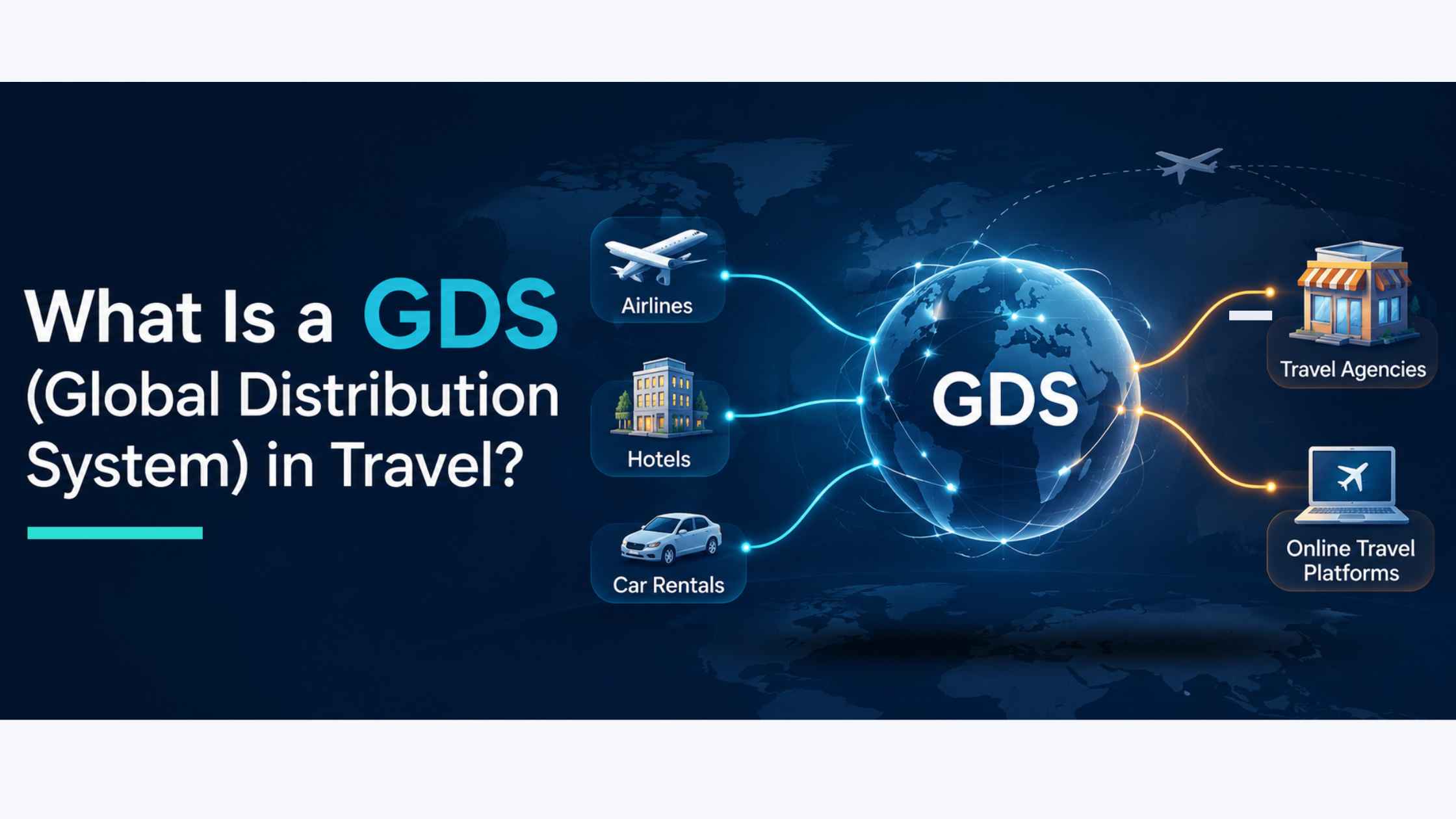
A GDS (Global Distribution System) is a network that connects airlines, hotels, car rental companies and rail operators with travel agencies, so agents can search, compare and book their inventory in real time from one screen. The three big ones are Amadeus, Sabre and Travelport, which runs Galileo and Worldspan.
If you've just opened an agency, or you run a DMC that's starting to sell flights, you'll hear "the GDS" in almost every supplier meeting. People talk about it as if everyone already knows what it is. Most guides don't help much either: they give you a definition, list the big three and stop there.
This guide goes further. You'll see how a booking actually moves through a GDS, what you can and can't sell through one, what it costs, how agencies get access, and whether your business needs one at all.
Key takeaways
A GDS doesn't own any seats or rooms. It passes requests between the people who sell travel and the systems that hold the inventory.
Amadeus, Sabre and Travelport handle most agency air bookings worldwide. Which one suits you depends mostly on your market.
Many low-cost airlines and a growing share of special airline fares (sold through NDC) aren't fully available through a classic GDS connection.
Agencies rarely pay a simple monthly fee. Contracts are usually built around booking volume, and the terms vary a lot.
Small agencies and most DMCs don't need a direct GDS contract. A consolidator or a booking platform that's already connected is often the smarter start.
What does GDS stand for?
GDS stands for Global Distribution System. The same three letters mean other things outside travel (the UK's Government Digital Service, for example, or NVIDIA's GPUDirect Storage), but in an agency it always means the booking network.
The idea is older than the internet. In the early 1960s, American Airlines and IBM built SABRE to replace the index cards and phone calls they used to track seats. Other airlines built their own systems, and over time these were opened up to travel agents and extended to hotels and cars. Amadeus was founded in 1987 by Air France, Iberia, Lufthansa and SAS. Galileo and Worldspan later came together under Travelport. That's how we ended up with three global players.
How does a GDS work?
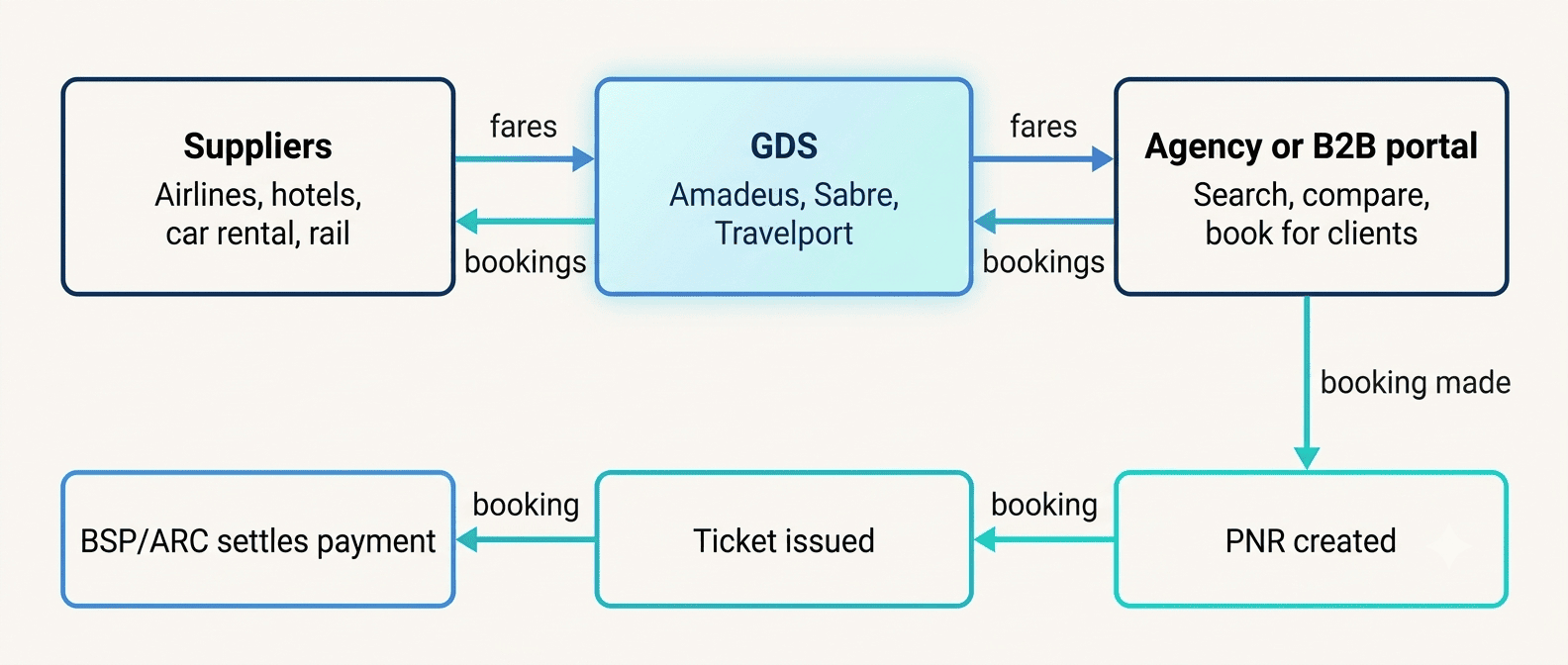
A GDS sits in the middle of two flows. Fares, schedules and availability travel from suppliers to sellers, and bookings travel back the other way.
A GDS sits between suppliers and agencies; it holds no inventory
Search, book, ticket, service
Search. An agent (or a booking engine on the agency's website) asks for flights from Dubai to London on a given date. The GDS queries the airlines' systems and returns options with live prices and seats.
Book. The agent picks a flight. The GDS sells the seat in the airline's system and creates a booking record called a PNR.
Ticket. For flights, the agency issues an e-ticket. The money is then settled between agency and airline through BSP (or ARC in the United States).
Service. Changes, cancellations, refunds and seat requests all go back through the same PNR.
What is a PNR?
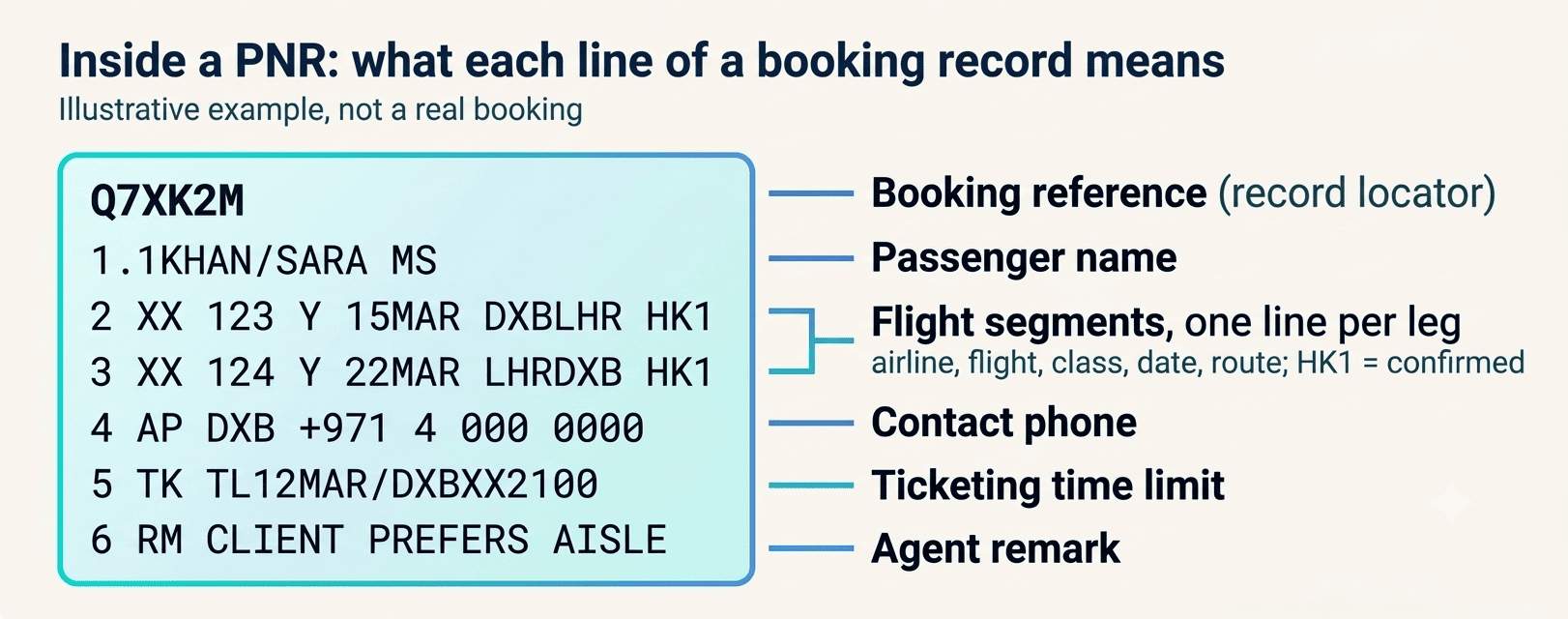
A PNR (Passenger Name Record) is the booking file. It holds the traveller's name, contact details, itinerary, ticket number and any special requests. Its six-character code is the booking reference you see on a confirmation.
Real PNRs hold more lines (fare details, ticket numbers, payment), and each GDS formats them a little differently, but every one is built around these basics.
What a GDS doesn't do
A GDS holds no inventory of its own. The seats live in the airline's reservation system (its PSS), and the rooms live in the hotel's central reservation system (its CRS). The GDS is the switchboard that lets thousands of agencies reach those systems in one standard way.
What can (and can't) you book through a GDS?
Flights are where a GDS is strongest. Hotels, cars and rail are well covered, but the picture gets patchy once you move into low-cost airlines and local services.
What a GDS covers well:
Scheduled flights on most full-service airlines
Hotel rooms at chains and many larger independent properties
Car rental from the major brands
Rail in some markets, and some cruise and insurance products
Where it falls short:
Low-cost airlines. Many sell mainly through their own websites or direct APIs and keep GDS distribution limited, because GDS fees eat into thin margins.
NDC-only fares. Some airlines now keep certain fares and bundles for their NDC channel (more on NDC below), so a classic GDS connection may not show them.
Local ground services. Transfers, guides, excursions and activities from local suppliers usually aren't in a GDS at all.
Small hotels and apartments. Many independent properties never connect to a GDS and sell through bed banks or online travel agencies instead.
That last group matters if you sell packages. A GDS will give you the flight. The rest of the trip usually comes from somewhere else.
Who uses a GDS?
The main users are the businesses that sell travel on someone else's behalf:
Travel agencies, from high-street shops to home-based advisors working through a host agency
Travel management companies (TMCs) that handle business travel for corporate clients
Online travel agencies (OTAs), which often combine GDS content with direct supplier connections
Consolidators, which buy and resell airline fares to smaller agencies
Hotels and airlines use it too, but from the other side: as a sales channel that puts their inventory in front of agents worldwide.
How hotels use a GDS
For a hotel, the GDS is a shop window aimed at travel agents, and especially at corporate travel bookers. The hotel's rates and availability flow from its property management system, through a channel manager or CRS, into the GDS. An agent in another country can then find the property, see live rates and book it in the same search as the flight.
This matters most for hotels that want business travel. Many companies only let their travelers book hotels that appear in their TMC's GDS-based tools, often at negotiated corporate rates. The trade-off is cost: hotels typically pay a GDS fee per booking plus commission to the agency, so smaller leisure properties often skip the GDS and sell through bed banks and online travel agencies instead.
Do DMCs and tour operators use a GDS?
Mostly for flights, and sometimes not even that. A destination management company earns its money on the ground: hotels it has contracted directly, transfers, guides, activities and local know-how. None of that lives in a GDS. DMCs usually source rooms through direct contracts and bed banks, and add flights through a consolidator or a GDS connection when a client needs them.
Tour operators sit in between. Those selling flight-inclusive packages often need GDS or airline API access for the air part, while the land part runs on their own contracts. For both, the real challenge is pulling these sources into one quote, one booking and one invoice.
Amadeus vs Sabre vs Travelport: the major GDS providers
Three companies run the global systems most agencies use. They all do the same core job, so the real differences come down to which airlines are strongest in your market, the tools and APIs on offer, and the contract you can negotiate.
Amadeus
Sabre
Travelport
Headquarters
Madrid, Spain
Southlake, Texas, USA
Langley, UK
Origins
Founded 1987 by Air France, Iberia, Lufthansa and SAS
Built by American Airlines and IBM in the early 1960s
Brings together Galileo, Worldspan and Apollo
Widely used in
Europe, the Middle East, India and much of Asia
North America, Latin America and parts of Asia
The UK, India, the Middle East (Galileo) and the US (Worldspan)
Agency products
Selling Platform Connect, Amadeus for Developers APIs
Sabre Red 360, Sabre APIs
Travelport+, Smartpoint, Travelport APIs
Regional strength shifts over time and by airline, so always ask each GDS to show you the content you'd actually sell before you sign.
Amadeus
Amadeus is usually reported as the largest GDS by agency air bookings, with especially deep content from European, Middle Eastern and Asian airlines. Its own company history marks the point it became the world's top travel reservation system: more than 180,000 travel agencies and airline sales offices connected, and 1 million bookings a day. It also has a big business selling technology to airlines and hotels. For developers it runs two API tiers: Self-Service APIs with pay-as-you-go pricing for smaller projects, and Enterprise APIs on negotiated contracts for agencies that need full booking and ticketing.
Sabre
Sabre is the oldest of the three and has long been the go-to choice for North American agencies and TMCs. Its agency workspace is Sabre Red 360, and according to Sabre, more than 400 airlines are reachable through a single connection to its platform. Sabre also absorbed Abacus, which used to be the leading GDS in much of Asia-Pacific, so it has a strong base there too.
Travelport
Travelport runs Galileo and Worldspan (Apollo has been folded in). Galileo has a large following among agencies in the UK, India and the Middle East. Its newer Travelport+ platform brings air, hotel, car, rail, NDC and low-cost carrier content into one place, whether agents work in Smartpoint or connect through APIs.
Regional GDSs
A few countries have their own systems, mostly tied to national airlines: TravelSky in China, Sirena-Travel in Russia and Infini in Japan. If most of your traffic is domestic in one of these markets, the local system may matter more than the big three.
GDS vs CRS vs PSS vs channel manager
These four get mixed up all the time. The simple way to keep them apart: a supplier owns its CRS or PSS, while a GDS and a channel manager are ways of selling that inventory to others.
System
What it is
Who owns or runs it
Who uses it day to day
PSS (passenger service system)
The airline's own reservation, inventory and check-in system
The airline
Airline staff
CRS (central reservation system)
A hotel or chain's master record of rooms and rates
The hotel or chain
Revenue and reservations teams
Channel manager
Software that pushes a hotel's rates and availability to many sales channels at once
The hotel, via a tech vendor
Hotel revenue managers
GDS
A shared network that lets agencies search and book many suppliers in one place
Amadeus, Sabre, Travelport
Travel agencies, TMCs, OTAs
For hotels, a booking often travels from the GDS to a channel manager or CRS before it reaches the property. For airlines, the GDS talks straight to the PSS.
GDS vs NDC vs direct API
NDC (New Distribution Capability) is a data standard created by IATA that lets airlines send richer offers to agencies: bundles, seats, bags and personalised prices that the older GDS format struggles to show. A direct API is a connection an agency builds straight to one supplier.
Classic GDS
NDC
Direct API
Content
Many airlines, hotels and cars in one place
One airline's full offer, extras included
One supplier only
Who controls the price
Fares filed in advance
The airline, in real time
The supplier
Extras (bags, seats, bundles)
Limited
Strong
Depends on the supplier
Changes and refunds
Mature, standard workflows
Still uneven between airlines
Supplier by supplier
Effort for the agency
One connection
One per airline, unless reached through an aggregator or GDS
One per supplier
Is NDC replacing the GDS?
Not really. What's happening is that the GDSs are becoming NDC aggregators themselves. Amadeus calls its version NDC-X, and Travelport+ shows NDC and classic fares side by side. Most agencies will end up with a mix: GDS content, NDC offers from the airlines that push them, and a few direct connections where they make sense.
How much does a GDS cost?
There's no public price list, and that surprises a lot of new agencies. The cost depends on who you are, how much you book and what you negotiate. What you can understand is who pays for what.
Airlines and hotels pay booking fees: Every time a flight segment is booked through a GDS, the airline pays the GDS a fee. This is the main way GDSs make money, and it's the reason airlines are pushing NDC and direct channels.
Agencies pay, or get paid, depending on volume: A typical agency contract sets a target for how many segments you book each year. Hit it and you may pay little or nothing, and larger agencies often receive incentive payments per segment. Miss it and you may face shortfall charges. Terminal, software or support fees can be added on top.
API access is priced separately: If you're building your own booking engine, the API terms matter more than the terminal. Amadeus, for example, offers Self-Service APIs with a free monthly quota and pay-as-you-go pricing beyond it, while full booking and ticketing sits on negotiated Enterprise contracts.
The costs people forget:
IATA accreditation, or the margin you give up working through a consolidator instead
Staff training, since the classic GDS screen uses typed commands
Integration work if you connect a website, mobile app or B2B portal
Contract length and exit terms (multi-year deals are common)
When you speak to a GDS, ask for the segment target, the incentive per segment above it, any shortfall penalty, every fixed fee, and what happens if you want to leave early. Get it in writing before you compare.
A worked example: how a segment target plays out
The figures here are made up to show the mechanics. Real rates vary by GDS, market and agency size, so use your own contract's numbers.
Say your contract sets a target of 10,000 segments a year. It pays you an incentive of 1.00 per segment above the target and charges 1.50 per segment you fall short (in your contract currency).
Good year
Slow year
Segments booked
12,000
8,000
Difference from target
2,000 above
2,000 below
Rate applied
1.00 incentive
1.50 shortfall charge
Result
You receive 2,000
You pay 3,000
Two things change the outcome more than the rates do. First, check what counts as a segment: many contracts exclude cancelled, duplicate or "passive" segments, so your real total can be lower than your booking count. Second, look at how the target is measured. A yearly target is far kinder to a seasonal business than a monthly one, because a busy summer can make up for a quiet winter.
Pros and cons of using a GDS
Pros
Cons
One connection to hundreds of airlines plus hotels and cars
Many low-cost airlines and some NDC fares are missing or limited
Real-time prices and availability
Contracts tied to volume can penalise small agencies
Mature tools for changes, refunds and reporting
The classic command screen takes time to learn
Accepted standard that corporate clients and TMCs expect
Little help with local ground services, activities or contracted hotel rates
Strong APIs to power your own booking engine
Building on the APIs yourself needs serious development work
How to get access to a GDS
There are two routes: sign your own contract with a GDS, or use a partner that already has one. Here's what the first route looks like.
Sort out ticketing authority. To issue airline tickets yourself you'll normally need IATA accreditation (or ARC in the US). If that's too much too soon, a consolidator or host agency can ticket for you.
Talk to more than one GDS. Ask Amadeus, Sabre and Travelport for a demo using the routes and airlines you actually sell.
Choose how you'll work. Agents can use the classic command screen, a point-and-click workspace, or an API that feeds your own booking engine or portal.
Negotiate the contract. Agree the segment target, incentives, fees, length and exit terms.
Train your team. Each GDS offers training and certification. Budget a few weeks before new agents are fully productive on the command screen.
Go live and review. Track your segments against the target from month one, so there are no surprises at year end.
The second route is often faster. Many booking platforms and B2B portals already hold GDS connections, so you can sell GDS content without negotiating your own contract on day one, and sign your own later once your volume justifies it.
Which GDS is best for travel agents?
There's no single winner. The best GDS is the one with the strongest content for your customers' routes, on terms that fit your volume. Use this checklist when you compare:
Airline content in your market. Which carriers do your customers fly most, and how complete is their content in each GDS?
Low-cost and NDC coverage. Can you reach the airlines that don't sell classic GDS fares?
Hotel and car content. Is it good enough, or will you add bedbanks anyway?
API quality. If you're building a website or portal, how good are the documentation, sandbox and support?
Contract terms. Segment targets, incentives, fees and length.
Local support and training. Is there a team in your region and time zone?
Fit with your software. Does it connect cleanly to your booking engine, mid-office and accounting?
Do you actually need a GDS?
It depends on what you sell and how much of it.
Small leisure agency: probably not yet. A consolidator or a B2B portal gives you flights without the contract, the targets or the training.
Corporate travel company (TMC): yes. Corporate clients expect GDS content, policy controls and reporting, and the volume makes the economics work.
Online travel agency: usually, alongside direct airline, NDC and bedbank connections.
DMC or inbound tour operator: rarely as a direct contract. Your value is on the ground, so flights through a GDS connection on your booking platform (or a consolidator) are usually enough. Your hotels and services come from direct contracts and bedbanks.
Where a GDS fits in a modern travel tech stack
A GDS is one source of content, not your whole system. In most agencies, DMCs and tour operators the setup looks something like this:
Content sources: a GDS for flights (plus NDC offers), bedbanks and direct contracts for hotels, and local suppliers for transfers and activities
Selling layer: a booking engine for your website, and a B2B portal for the agents and partners who resell for you
Back office: quotes, bookings, supplier payments, invoicing and accounting in one place
The hard part isn't connecting to a GDS. It's making a GDS flight, a contracted hotel and a local transfer behave like one trip, with one price, one booking record and one invoice.
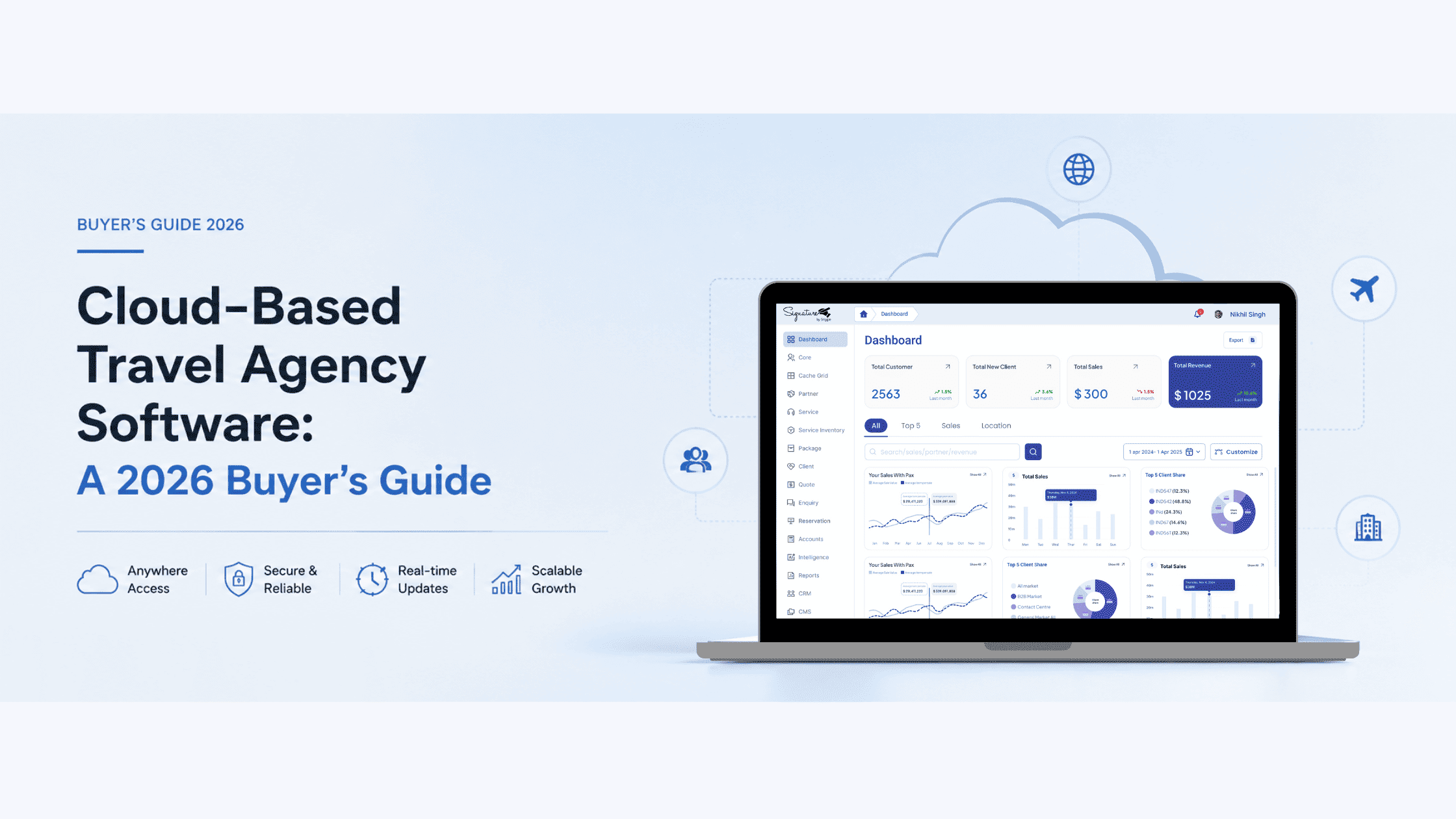
That's the gap platforms like Sriggle are built for. Sriggle's Signature connects to Amadeus and Travelport (Galileo), alongside hotel, activity and transfer suppliers, so you can quote and book them together. You can read more about its flight booking software, the Travelport API and Sabre API integrations, its B2B travel portal, and the accounting side that ties bookings to invoices.
What's next for the GDS
The GDS isn't going away, but it is changing shape. Three shifts are already visible:
NDC inside the GDS. Instead of agencies connecting to every airline separately, the GDSs are pulling NDC offers into the same search as classic fares.
Modern APIs. Newer JSON-based APIs are replacing older formats, which makes it easier to build websites, apps and portals on top of GDS content.
Smarter retailing. Airlines want to sell bundles and extras the way online shops do, and the GDSs are reworking their tools so agents can sell them too.
For agencies, the takeaway is simple: choose technology that can handle GDS, NDC and direct content together, so you're not rebuilding every time an airline changes how it distributes.


 Booking & Reservation Systems
 Travel Planning & Itinerary Management
 Travel Business & Agency Management

 SOC 2
 ISO
 PCI DSS
